
Monday Messages…

Shhhhhhh… we’re about to enter the silent letter section of the library. There’s a number of hidden letters out there, just hoping to be found. I know this because I’ve been searching them out.

Why would be the first operative question!

When it comes to sneaky letters hiding in plain sight, I’ve been wracking my brain trying to understand the reasoning for this odd addition to the English language. If you wanted to be hidden, fine, but then why keep peeking out of words that didn’t need you there, in the first place?

Here we come Mr. McGoogle, so make us proud…

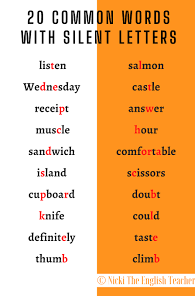
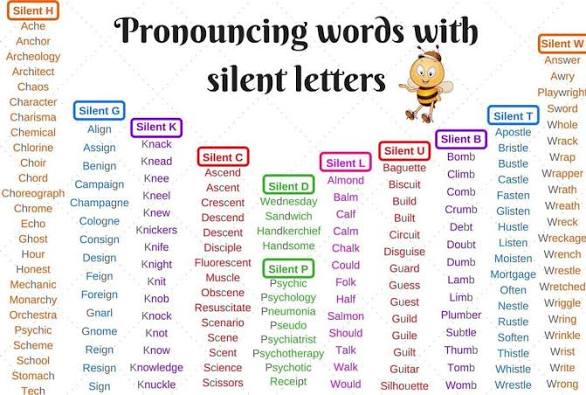
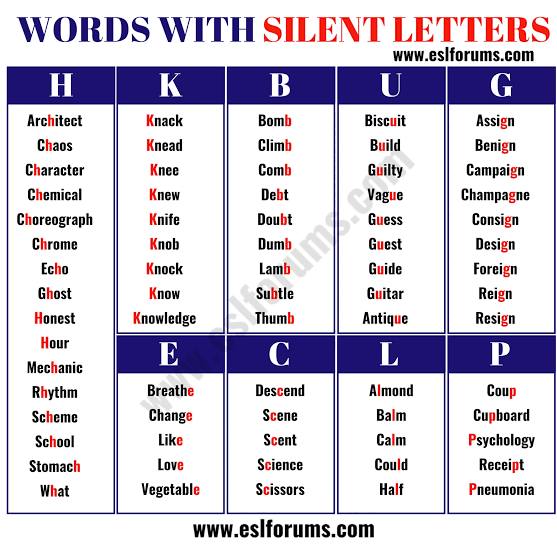
Silent letters are letters in English words that are written but not pronounced, appearing in roughly 60% of English words. They exist due to historical pronunciation changes, etymology, or to differentiate homophones. Common silent letters include b (climb), k (knee), w (write), h (hour), and t (listen), occurring at the beginning, middle, or end of words.

Wow!

Ok Mr. McGoogle, you didn’t have to do us that proud, really!

Oddly, I didn’t actually know that these silent letter words made up 60% of all English words. It’s rather embarrassing, if you think about it. Here we are, thinking we are so smart, but we still use silent letters like a salt shaker. Now my brain hurts.

So, if these letters aren’t needed, I wanted to know what the purpose was for adding them, so long ago.

Come on… let’s ask!

AI Overview

Silent letters exist primarily because English spelling was standardized before pronunciation changed, and because of efforts to reflect words’ original Latin, Greek, or French roots. They help distinguish homophones (e.g., knights vs. nights), indicate long vowels (e.g., rate vs. rat), and remain as remnants of older, fully pronounced words. 

Key reasons for silent letters: Etymology & History: Many letters were originally pronounced. For example, knee was pronounced with a hard ‘k’ in Old English, a practice that disappeared over time, but the spelling remained.

  • Renaisance Spelling Changes: Scholars often added letters to words to make them look more like their Latin or Greek origins, such as adding a ‘b’ to debt and doubt to match the Latin debitum and dubitare.
  • French Influence: Following the Norman Conquest, French scribes altered English spelling, which brought in silent letters.
  • Homophones: Silent letters help differentiate words that sound the same, such as “in” and “inn,” or “so” and “sew”.
  • Print Standardization: Early printing presses froze spellings, which meant older, non-phonetic spellings were locked in even as pronunciation continued to evolve. 

These seemingly useless letters often provide clues to the history and meaning of a word, even if they no longer correspond to a sound in modern English. 

Well, I guess if you want to give such a smart answer, Mr. McGoogle, fine! But you could have led with this explanation, in the first place. Maybe it’s my fault, as I should have asked this question first.

So, I’m going to give this rule a free ride, due to the answer given.

I can’t really argue with logic like this, so we’ll accept it as a valid answer to my queries, just this once. I don’t even have a snappy retort, or witty statement that might undermine such reasonings.

However, I will say that we already knew about Homophones from last week, so there’s that!

Eyes before ease…

… except after seas?

No, that’s not right. I believe the English language rule states that it’s i before e, except after c’s. What I’d like to know is why? If they both sound the same, why on earth are we throwing in a complicated if and or but with these words. Didn’t anybody ever hear of the adage, “if it ain’t broke, don’t fix it!” ? I’ve heard of it!

Before I get myself in an unnecessary bother, maybe we should first ask Mr. McGoogle to try and work out the problem.

Question #1 should be to establish what the actual rule states. No one should go on here say about a thing, but should instead seek the facts. Let’s do this…

According to the AI Overview,

In the English language, a common mnemonic spelling rule is: “I before E, except after C

However, the full, more accurate rhyme often includes: “…or when sounded as ‘ay’ as in neighbor or weigh”

Key Details Regarding the Rule: “Cie” Words: Sometimes ie follows a c anyway, such as in science, glacier, ancient, and sufficient.

The “C” Exception: When the i and e combination follows a c, the order is usually ei (e.g., receive, ceiling, deceive, conceit).

The “Ay” Exception: When the ei combination makes a long “a” sound (like “ay”), e comes before i (e.g., neighbor, weigh, vein, sleigh).

Other Exceptions: There are many words that break this rule, such as weird, seize, leisure, protein, and foreign.

So, ok, I can agree with this ruling as long as it can be clearly determined by the pronunciation of the word. That part makes sense, but what screws everything up is the fact that there are so many varying accents from differing nationalities. What then? Unless one is prepared to pull up a voice modulator every single time one of these words come up, the margin for error is incredibly wide… in my humble antsy opinion.

I suppose if we only had a handful of words that utilized this particular linguistic merry-go-round, it wouldn’t cause me such aggravation. But guess what? The English language is smothered in the ie, ei, except after c, or ay rule. Not just that but we get to also separate words like weird, seize, leisure, protein, and foreign, as these words break all the rules. What’s an ant to do, here?

Well, figure things out is what I need to do, if I’m to make a top-notch journalist! If children can learn it, then so too can an ant… this ant, to be exact!

Monday Messages…

You thought Mary Poppins came up with the most nonsensical, and difficult word to say out loud. I beg to differ!

While Supercalifragilisticexpialidocious might take us on a fabulous carousel ride, this next word will take us for a somewhat different journey. What is this word in which I speak? Let me check google for the correct spelling, as it’s a doozey!

Juxtaposition!

Personally, I find it easier to remember the song by Julie Andrews about her super word, comparatively. At least she used a great song to help remember how it’s pronounced! Unfortunately for both words, breaking things down to each’s roots can be a fantastical journey, in and of itself! But, as I’m a staunch supporter of the English language, no matter how ludicrous it may seem, I shall press on for all our sakes!

Here we go…

Definitions from Oxford Languages · Learn more

jux·ta·po·si·tion

noun: juxtaposition; plural noun: juxtapositions

  1. the fact of two things being seen or placed close together with contrasting effect.”the juxtaposition of these two images”

So, the definition’s great and all, but I wonder where it originated from? Here’s something that makes me laugh. We are reading, writing, and speaking an English word that originated from two differing languages, neither coming from our home land.

Juxta comes from Latin, and position comes from the French… go figure!

So, in order to speak in English form correctly, apparently, one must first pilfer all it’s bits and pieces from other languages. The whole robbing Peter to pay Paul thing, I surmise. Maybe that’s the reason English is such a complicated language, with all sorts of rules, exceptions, and spelling bonanzas, but I’m only speculating.

For the last several days, I’ve been attempting to find uses for this extravagant word, in replacement of simpler terms. Not only is it rather stupid, as very few people even use it nowadays, but it just seems over lengthy for no apparent reason.

Why can’t we keep things simple?

Just say, “Hey, those two things are different” verses the alternative…

The juxtaposition of two such facts seemed to me auspicious. The juxtaposition of those two is comprehensible. The juxtaposition of the two names was probably not accidental. The juxtaposition of the two items suggested a programming muddle.

It seems to me that they added more big words, with each passing sentence. Great! Now we have to look up auspicious and comprehensible, as well. Nope!

Until somebody can come up with songs for all these fancy words, I’m sticking with my favorite Mary Poppins word!

Definitions from Oxford Languages · Learn more

su·per·ca·li·fra·gil·is·tic·ex·pi·a·li·do·cious

/ˌso͞opərˌkaləˌfrajəˌlistikˌekspēˌaləˈdōSHəs/

adjective

informal

adjective: supercalifragilisticexpialidocious; adjective: supercalifragilistic

  1. extraordinarily good; wonderful.

Yep! I love a two word definition, don’t you? So much easier to remember. But, to be honest, I just like singing the song…

Monday Messages…

It’s amazing what kind of stuff you can find in a dictionary, but what if it’s not amazing stuff… what if it’s inamazing? Apparently, that’s not a real word, and I even checked!

So, what’s with Famous and Infamous? Why didn’t they just say famous or average… famous or unknown… or even, famous or boring? I think these are valid questions.

Before I go judging those who created the English language rules, I’ll make an effort towards some good old google research… that’s what everybody else does.

According to Google,

Famous and infamous both describe someone or something that is widely recognized, but they differ significantly in reputation: famous means well-known for positive, admirable, or neutral reasons, while infamous means famous for bad, evil, or scandalous actions. While a celebrity is famous, a criminal is infamous. 

Sorry, but that’s sort of a silly reason to do that with the word famous. You’re either famous or creepy, so why muck up the language waters?

What stops us from switching up all words and giving them nefarious opposites by adding two letters?

I thought to find out how many words they’ve actually done this to… oh, and they call these words Antonyms, if you were at all wondering.

Google says,

Many English words form opposites (antonyms) by adding the prefix in- (or its variations im-, il-, ir-) to indicate “not” or “opposite of.” Common examples include accurate/inaccurate, complete/incomplete, visible/invisible, formal/informal, and sensitive/insensitive

Ok, in some instances, I guess it actually does make sense, and also saves a good amount of time in explaining a thing… but all of them? I’m still not sold!

In most of these words, adding the in seems more like holding a mirror up to a word, and seeing it’s perfect opposite. But I believe that some words are too broad of a word to simply flip-flop it’s meaning with two simple letters.

Here’s where things get really irritating for me, personally…

Valuable and Invaluable,

Valuable and invaluable are often confused, but they are not antonyms; rather, invaluable is an extreme form of valuable. Valuable means having high worth, importance, or monetary value. Invaluable means something is so extremely precious, useful, or essential that its worth cannot be calculated—it is truly priceless. 

Now, they’ve added a new in word, but with an entirely different definition to remember.

How on earth did any of us learn to read as children, honestly? Grown ups need to make up their minds, I think.

Monday Messages…

What’s the deal with the whole i before e except after c, song and dance? And, am I the only one who thinks that there’s not a big difference in the word’s pronunciation and meaning if you flippy the little letters around?

So, why did they make that rule, then? I’m going to find out!

Simply because a rule doesn’t make sense doesn’t mean that it’s wrong. Although I think it’s a rather silly rule of the English language, rather than something that makes any real sense, maybe we should just ask Google…

According to the ai generator,

“I before e, except after c, or when sounding like ‘a’ as in ‘neighbor’ and ‘weigh'” is a popular English spelling mnemonic: use IE (like believe, thief) unless the letters follow a C, where you use EI (receive, ceiling), or when they sound like a long ‘A’ (neighbor, weigh). It’s a useful guideline but has exceptions, so memorizing tricky words like weird, seize, and height is also key.

How it works

  • IE: In most words with a long ‘e’ sound, ‘i’ comes before ‘e’ (e.g., believe, piece, thief).
  • CEI: After the letter ‘c’, the order reverses to ‘ei’ (e.g., receive, ceiling, deceit).
  • EIA: When the sound is like the ‘a’ in neighbor, use ‘ei’ (e.g., neighbor, weigh, vein).

Common exceptions (memorize these!)

  • weird, seize, leisure, height, science, glacier, caffeine, protein.

Why it’s not a perfect rule

  • English spelling is inconsistent due to influences from other languages, so this is a guideline, not a strict law.

Nope! I still think it’s more of a confusion than any help! Can’t we just keep things simple?

All this early morning research made me hungry. It’s off to share some oatmeal with Wiwohka. She makes it the best! Oh, don’t think I forgot about you, too…

Oatmeal cookies, of course!